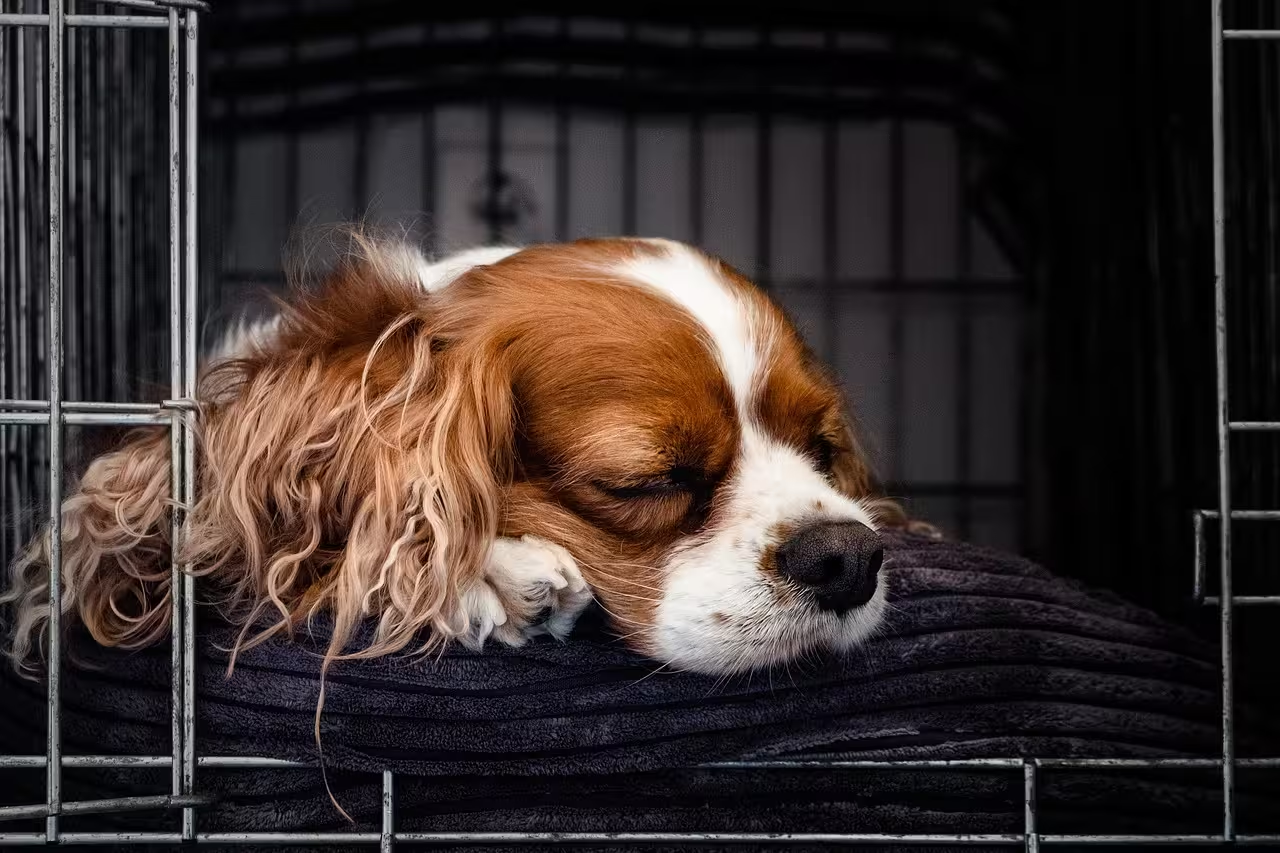
This series is your roadmap for raising a happy, well-adjusted pup. It complements our book, Help! I Got a Puppy, and offers step-by-step guidance by stage of puppy parenthood.
If you’ve just brought your puppy home, start with our complete guide to the first 48 hours with a new puppy, where we walk you through the first night, early routines, and common mistakes to avoid.
A friend texted me recently:
“We take them out every hour. We praise them outside. But they still pee on pads. And carpets. And tile. And sometimes they eat it. We keep them confined to one room. We just don’t want to crate train.”
They weren’t being negligent. They were trying. They were also exhausted.
At one point he described the puppies as “bottomless pits of pee and poo.”
If you’re here because your puppy keeps peeing in the house, because you’re dealing with pad trained puppy accidents, or because you’re wondering whether crate training is necessary, here is the straightforward answer:
Yes.
Crate training for puppies is not optional if your goal is reliable house training, reduced accidents, and a predictable routine. Effort alone does not solve potty confusion. Structure does.
This isn’t a bad puppy. It’s a management problem. And management requires clarity.
Most people struggling with how to potty train a puppy are not failing due to lack of commitment. They’re failing because they are unintentionally teaching two opposing behaviors.
The common pattern looks like this:
From the human perspective, it feels like maximum effort. From the puppy’s perspective, both indoor and outdoor elimination are acceptable.
Dogs learn through repetition and environment. They do not generalize well. If peeing inside is possible, it will continue. Every accident rehearsed indoors strengthens the habit.
Taking a puppy outside every hour does not override habit formation if indoor elimination is still an option.
Room confinement feels responsible. In practice, it often prolongs confusion. A room still allows separation between sleep space and bathroom space. A properly sized crate does not.
Clarity speeds learning. Mixed messages delay it.
Crate training for puppies works because dogs instinctively avoid soiling their sleeping space. A properly sized crate limits movement, reinforces bladder awareness, and prevents indoor accident rehearsal — which accelerates potty training.
Dogs are naturally den-oriented. When given a small, enclosed resting space that is just large enough to stand, turn, and lie down — but not large enough to create a separate bathroom corner — they are far more likely to hold their bladder.
This is not punishment. It is structured management that uses instinct to support learning.
Without that structure, you are relying entirely on supervision and timing. With it, biology helps you.
A crate:
Without a crate, you are relying entirely on supervision and timing. With a crate, you are using biology to support behavior.
That leverage accelerates house training.
If your puppy keeps peeing inside despite frequent potty trips, the issue is not frequency. It is access.
Crate training removes access.
Crate training is often discussed only in the context of accidents. That misses half the story.
A well-introduced crate becomes a defined, predictable resting space. Over time, many dogs choose it.
My first dog, Toronto, protested the crate at first. We introduced it calmly and consistently. Within weeks, he began retreating there on his own when the apartment felt busy. If he was tired, that’s where he slept — even with the door open.
The first time I left him home uncrated, I returned to find him inside the crate anyway, calm and settled.
It was no longer confinement. It was his space.
Later, with Ranger — who we raised during the pandemic — we were home constantly and introduced structured independence more gradually. Eventually, he created his own version of a crate under my desk: enclosed, tucked in, secure. When we leave, he curls up there naturally.
Dogs seek predictable, enclosed resting spaces. Crate training provides one intentionally.
When used correctly, a crate is not restrictive. It is stabilizing.
If you are frustrated, here is what crate training for puppies directly addresses.
The fastest way to stop a puppy from peeing in the house is to eliminate unsupervised freedom.
A crate prevents rehearsal. Without rehearsal, habits weaken. With consistent crate use and scheduled potty trips, house training progresses quickly.
If you are transitioning away from indoor pads, understand this: pads teach indoor elimination. You cannot reward outdoor peeing while maintaining an indoor bathroom option and expect clarity.
Removing pads and implementing crate training creates a clean behavioral shift.
If your puppy is eating poop, access is part of the equation. Indoor elimination increases opportunity. Opportunity increases repetition.
Reducing indoor accidents reduces access. Reduced access reduces the behavior.
Management matters.
Unstructured freedom invites:
Crate training protects both your home and your puppy during the stage when impulse control is still developing.
For a broader foundation on raising a well-adjusted dog, review our Puppy 101 guide.
A structured crate routine teaches a puppy to settle independently. This is foundational for preventing long-term anxiety issues.
When a puppy learns that short periods of calm separation are normal and predictable, independence develops naturally. Chaos and constant access to you do not build that skill.
Structure builds resilience.
Many owners attempt to avoid crates by using baby gates or closing off a kitchen. While understandable, this approach often prolongs potty training.
A room still provides space to separate sleeping and elimination areas. That undermines bladder awareness.
A crate creates a single-purpose resting zone. That clarity is why crate training for puppies consistently outperforms room confinement in early house training.
Common concerns include:
Used improperly, any tool can be harmful. Used correctly, a crate is temporary structure that creates long-term freedom.
Freedom without structure leads to frustration. Frustration leads to correction, inconsistency, and relationship strain.
Structured crate training leads to clarity, faster potty training, and eventually more freedom.
The goal is not lifelong confinement. The goal is accelerated learning.
If your crate training first week did not go well, reset with fundamentals:
1. Proper Size
Large enough for comfort. Small enough to prevent bathroom corners.
2. Potty Before Crate
Always start with an empty bladder.
3. Short Initial Durations
Build gradually. Avoid dramatic exits and reunions.
4. Consistency
Use the crate for naps, overnight sleep, and short absences. Predictability builds security.
If you’re still in the first week with a new puppy, start there. Crate training works best when it’s part of a structured first-week plan.
You can eventually house train without a crate. It typically takes longer.
Expect:
Most prolonged potty training issues stem from inconsistent structure, not stubborn dogs.
Crate training shortens the learning curve.
Is crate training necessary?
If you want efficient, predictable house training and reduced accidents in weeks instead of months, yes. While alternatives exist, crate training is the most reliable management tool for young puppies.
How long can a puppy stay in a crate?
A common guideline is that a puppy can hold their bladder for roughly their age in months (in hours) during the day. Overnight may be slightly longer. Individual variation applies.
Should I crate my puppy at night?
Yes. Nighttime crate training prevents wandering accidents and accelerates bladder control.
What if my puppy cries?
Confirm basic needs are met. Brief protest is normal. Immediate release for crying can reinforce the behavior.
Can older puppies be crate trained?
Absolutely. It may take more consistency if habits are established, but structure remains effective at any age.
My friend eventually committed to crate training.
Within a week, accidents dropped significantly. The poop eating stopped. Household stress declined.
The puppies didn’t change. The environment did.
Crate training for puppies is not about confinement. It is about clarity. Clarity builds habit. Habit builds confidence. Confidence leads to freedom.
If your puppy keeps peeing in the house and you feel stuck, the solution is not more effort. It is better structure.
And in early puppyhood, structure almost always starts with a crate.
Calm boundaries now.
Freedom later.
